A First Look at the Summer Triangle
Use the Summer Triangle to recognize Vega, Deneb, and Altair, then track their changing positions through a summer evening with a simple observing plan.
The most common mistake with the Summer Triangle is looking for a triangle that seems to stand upright, like one drawn on a page. The stars do make a broad triangle, but its tilt changes with the hour and your location; expecting a fixed orientation can make an easy pattern feel elusive. A simple plan for finding the Summer Triangle is to recognize its three bright stars first, then notice how the whole figure shifts as the evening advances.
What is the Summer Triangle?
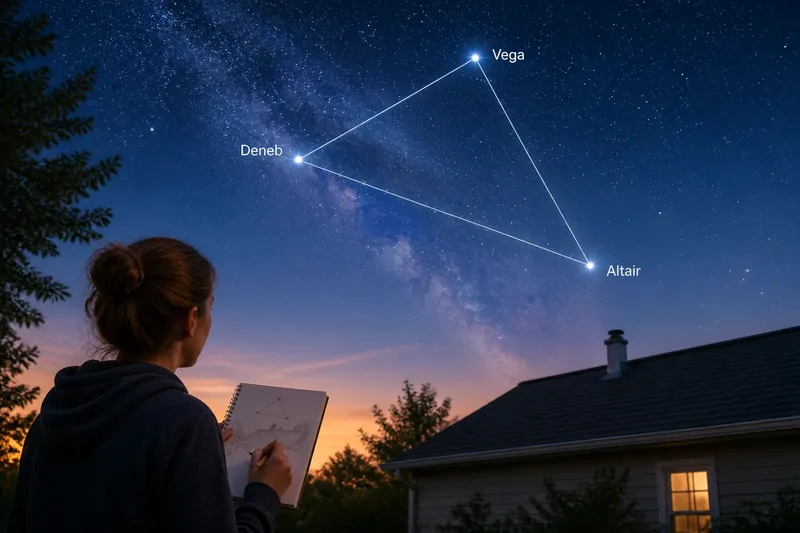
The Summer Triangle is a seasonal asterism: a recognizable star pattern that is not itself one official constellation. Its corners are Vega, Deneb, and Altair, each belonging to a different constellation. Vega is in Lyra, Deneb in Cygnus, and Altair in Aquila.
The pattern is large, so it helps to think of it as a region of sky rather than a small symbol. Vega and Deneb form one side, Vega and Altair another, while Deneb and Altair span the broad base. The three stars are conspicuous, but their surrounding constellations can be harder to distinguish, especially in a bright urban sky. You do not need to identify those constellations to recognize the triangle.
“Summer” describes the season when the pattern is especially prominent in the evening for many observers in the Northern Hemisphere. The stars are not confined to that season, and observers farther south may see a different height or seasonality. Your latitude, local horizon, and the time of night all affect what is visible.
When can I see the Summer Triangle?
Look for it on a clear evening from late spring into autumn in the Northern Hemisphere. As summer progresses, the pattern becomes easier to catch soon after dusk; later in the season it is already higher in the sky by the time darkness settles. The exact timing shifts with date and location, so treat this as a broad seasonal window rather than a calendar appointment.
Choose a place with a broad view of the sky, ideally away from direct lamps and tall buildings. A park, open yard, or clear stretch of shoreline can work. Check that clouds are not covering the eastern or overhead sky, and give your eyes time to adjust to the dimmer view. If you need to check a phone, lower its brightness and keep the screen use brief.
Start by looking east or southeast after dusk, where the stars are rising into view. Later in the evening, the triangle stands higher and shifts toward the south for many Northern Hemisphere observers. Near the end of the night, it moves toward the western sky. These directions are a useful broad guide, not a substitute for your local horizon: buildings, hills, and latitude can change the view.
How do I recognize Vega, Deneb, and Altair?
Find Vega first. It is often the most striking of the three and appears high in the eastern or northeastern sky on summer evenings at many northern locations. From Vega, look for Deneb farther toward the northeast and Altair toward the southeast. Together, the three make a large, uneven triangle, not an equilateral one.
Use the shape as a memory aid, not a rigid diagram. Vega is the bright corner, while Deneb and Altair sit on opposite sides of the broad lower span when the pattern is rising. As the figure climbs and turns, those descriptions of “upper” and “lower” become less useful. The star-to-star relationships remain more dependable than the direction in which a drawn triangle seems to point.
Once you have the three corners, take a moment to notice their different surroundings. Vega is a bright anchor in the smaller constellation Lyra. Deneb marks the tail of Cygnus, often imagined as a flying swan whose body stretches along the Milky Way. Altair is part of Aquila, the Eagle. Those images may help you explore, but they are optional; recognizing the three stars is the main task.
How can I follow the triangle through the evening?
Choose a comfortable spot and observe the same patch of sky at three different points in the evening. You do not need to stay outside continuously: a quick look, a written note, and a later return are enough to notice the change. Make a simple sketch of the three stars against a roofline or tree edge, then compare the pattern with the same landmark later.
- At dusk: Locate the triangle as the sky darkens. Note which corner is highest and where the pattern sits relative to a nearby building or tree.
- Later: Look again after the sky has grown darker. The stars should appear higher and shifted across the sky, while their spacing and triangular arrangement remain recognizable.
- Before bed or near dawn: If the pattern is still above your local horizon, check how its orientation has changed. It may be heading toward the west or becoming lower there.
Imagine you begin in an open backyard just after dusk and spot Vega above a roof, with Deneb and Altair forming the other corners. You sketch the three points and the roof ridge, then return later in the evening. The expected observable result is that the triangle sits in a different place relative to the roof and its tilt has changed, while the same three stars still define the pattern.
This is a way to notice Earth’s rotation in the sky: over the course of an evening, stars appear to move from east to west as Earth turns. The triangle’s stars do not change their arrangement over those few hours in any noticeable way. What changes is their position and orientation in your view.
Why does the Summer Triangle look different from night to night?
Its appearance depends on when you look, where you observe from, and what blocks or brightens the sky. Early in the season, the triangle may be lower when darkness begins. Later, it can be higher at the same point in the evening. A different observing time can make the same seasonal change seem even larger.
Clouds, haze, moonlight, and nearby artificial lighting can also affect how clearly the stars stand out. If one corner seems missing, scan the area patiently rather than assuming the pattern has changed. A thin cloud can dim one region, while a roof or tree can hide a star near the horizon.
Do not expect the triangle to match an illustration exactly. Diagrams often place north at the top and show the pattern in a chosen orientation. In the real sky, “up” depends on the time, direction you face, and your position on Earth. Turn the diagram to match the sky, or set it aside and follow the three bright points directly.
Do I need binoculars or a sky app?
No equipment is needed to identify the three main stars. Start with unaided eyes; the triangle is large and its brightest corners are visible without magnification when the sky and horizon allow. Binoculars are not usually helpful for locating the overall pattern, because their narrow field of view can make it harder to see all three corners at once.
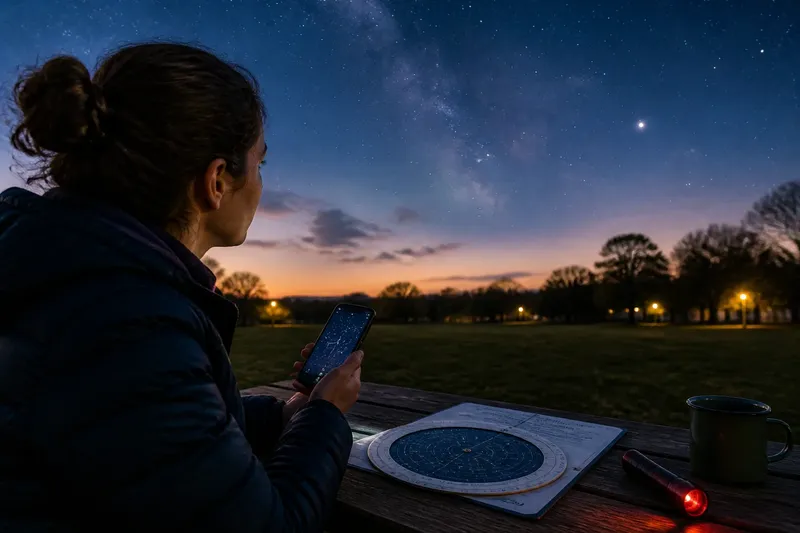
A star chart or sky app can help if you are unsure which bright star is which. Use it to confirm the pattern, then look up again and try to remember the relationships among the stars. The point is not to keep a device aimed overhead, but to let the chart connect names with what your eyes can see.
It is not worth chasing a perfectly dark location or buying equipment just to make a first identification. A reasonably open view and a few unhurried looks are more useful than complicated gear for this task. If you later want to explore the Milky Way or fainter stars, binoculars and a darker site can add detail, but they are not prerequisites.
What do people ask about the Summer Triangle?
Is the Summer Triangle a constellation?
No. It is an asterism, a familiar pattern formed by stars that belong to three separate constellations: Lyra, Cygnus, and Aquila. The pattern is a convenient landmark, not a boundary-defined constellation of its own.
Can I see the Summer Triangle from the Southern Hemisphere?
Many southern observers can see at least part of it, but its height and seasonal timing differ from the Northern Hemisphere view. Your latitude and local horizon determine whether all three stars rise high enough to see clearly.
Why does the triangle seem to rotate?
Earth’s rotation makes the stars appear to travel across the sky during the night, changing the triangle’s orientation from your viewpoint. The stars remain in the same pattern relative to one another over an evening.
What should I do if I can find Vega but not the other stars?
Wait until the sky darkens further, then look outward from Vega for the two other bright corners rather than searching for a small, precisely oriented shape. If clouds or a blocked horizon are in the way, try again from a clearer part of the sky or on another evening.
How can I make the next night easier?
Keep a short note of the date, approximate time, direction you faced, and what the triangle was near. A rough sketch is enough; it need not resemble a chart. On another clear evening, compare the pattern at a similar time. You may notice a seasonal shift in where it appears at dusk, or an evening shift if you check at different hours.
For a first look at the Summer Triangle, the most useful habit is to identify the same three bright stars and return to them. Start with Vega, connect it to Deneb and Altair, and use a familiar horizon feature to track their changing position. That small routine turns a broad patch of stars into a dependable marker for the summer sky.