Why the Moon Seems to Change Shape
Why the Moon seems to change shape comes down to sunlight and orbit. Learn to read its phases, understand the terminator, and predict what you will see.
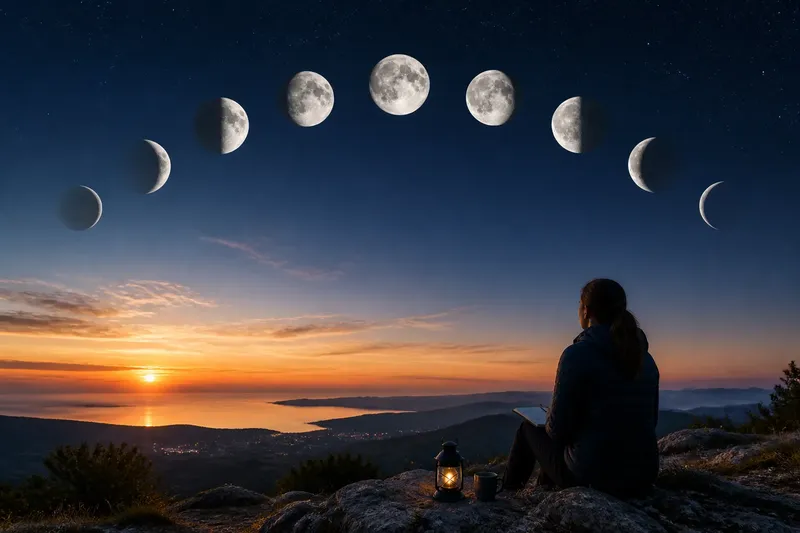
The most common mistake in explaining why the Moon seems to change shape is to imagine Earth’s shadow sliding across it every month. That shadow causes lunar eclipses, but ordinary phases come from the Moon orbiting Earth while sunlight illuminates half of its surface. Confusing the two makes a steady, observable cycle seem like a series of eclipses.
Sunlight lights half the Moon, but we see changing portions
The Moon does not produce its own visible light. Sunlight falls on the half facing the Sun, while the opposite half remains dark. From Earth, we see different amounts of that sunlit half as the Moon moves along its orbit.
Think of a ball held near a lamp in a dark room. The lamp always lights half the ball, but as you move around it, the lit portion you see changes. The Moon-and-Sun arrangement is more spacious, and Earth is the observer’s viewpoint, but the geometry is similar.
The boundary between lunar day and lunar night is called the terminator. It is not a physical edge or a shadow cast by Earth. Its position across the Moon’s visible disk shifts as the Moon travels around us, making the lit area appear to grow or shrink.
Moon phases follow its changing position in orbit
One complete cycle of phases, from new Moon to new Moon, is called a synodic month. It reflects how long it takes the Moon to return to roughly the same position relative to the Sun as seen from Earth. The Moon also orbits Earth against the background of distant stars, but Earth is moving around the Sun too; that extra motion is why the phase cycle takes longer than one orbit measured against the stars.
At new Moon, the Moon lies in the part of its orbit where its sunlit side mostly faces away from Earth. It is near the Sun’s direction in the sky, so the bright face is difficult or impossible to see against daylight. As it moves onward, a slender crescent becomes visible after sunset or before sunrise, depending on its position.
At first quarter, the Moon is about a quarter of the way around its phase cycle, and half of the visible disk appears lit. The name can mislead: it describes the Moon’s progress around its orbit, not the fraction of the disk illuminated. The same distinction applies at last quarter, when the other half appears bright.
At full Moon, Earth is roughly between the Sun and Moon, so the Moon’s Earth-facing side is illuminated. It rises near sunset and stays visible for much of the night. Most months, the alignment is not exact enough for Earth’s shadow to fall on it; a lunar eclipse occurs only when the geometry is especially close to a straight line.
What can you tell from the Moon’s lit edge?
A few simple observations make the geometry easier to recognize. Look at the Moon at the same time on successive evenings, and note how its illuminated portion and its place in the sky change. No special equipment is needed; a notebook or a quick sketch can help you compare what you remember with what appears.
- Waxing means growing. The visible lit portion increases as the Moon moves from new toward full. A waxing crescent has a narrow bright curve; waxing gibbous describes a disk that is more than half lit.
- Waning means shrinking. After full Moon, the illuminated portion visible from Earth decreases. Waning gibbous comes before last quarter, followed by a waning crescent.
- The bright edge faces the Sun’s direction. The Sun may already be below your horizon, but its direction still helps explain which side of the Moon is lit. Perspective and the Moon’s tilt in the sky can make the curve appear angled rather than upright.
- A crescent can appear in twilight. A thin crescent is easiest to notice when the sky is not fully dark, but it may sit low and set soon after the Sun. Clear horizons and an unobstructed view matter more than a telescope.
Say you notice a thin crescent low in the western sky after sunset. If you make a simple sketch and look again on later evenings, you should see the bright curve widen and the Moon remain above the horizon longer after sunset. That visible change is the Moon’s changing position relative to the Sun, not Earth’s shadow crossing its face.
Why does the Moon look different at different times?
Why does a crescent appear after sunset?
After new Moon, the Moon has moved a little away from the Sun’s direction, so a small portion of its sunlit side can be seen from Earth. It is often visible in evening twilight, though its height and visibility depend on where it is in its orbit and on local conditions.
Why does the Moon rise at a different time each day?
The Moon moves eastward along its orbit while Earth turns beneath the sky, so it generally rises later on following days. The amount varies with the Moon’s path and the observer’s location; there is no single rise time that applies everywhere.
Why can I sometimes see the dark part of a crescent?
During some crescents, faint light on the Moon’s unlit portion is visible because sunlight reflected from Earth reaches the lunar surface and reflects back toward us. This subtle glow is called earthshine. It is most noticeable when the crescent is slim and the sky is dark enough to distinguish the faint disk.
Does Earth’s shadow make the regular phases?
No. Earth’s shadow reaches the Moon only during a lunar eclipse, when Sun, Earth, and Moon align closely enough. The routine phases occur because the Moon’s orbit changes how much of its sunlit half we can see.
The Moon’s tilt changes the crescent’s orientation
A familiar crescent drawing often shows a curve with its tips pointing sideways, but the real Moon may look like a tilted smile, a shallow bowl, or a slim arc standing on end. This does not mean the phase mechanism has changed. The apparent orientation depends on the Moon’s position in the sky and the direction you are facing as you look.
Near the horizon, the Moon’s path can meet the horizon at a different angle than it does higher in the sky. Your latitude and the season also affect how that path appears. So a crescent that looks upright from one place or at one hour may look slanted from another viewpoint. The bright edge still faces the Sun’s direction, even when the familiar illustration seems rotated.
It is not worth trying to memorize a single rule such as “the crescent always opens upward.” Such rules fail as the Moon’s angle changes. Instead, locate the Sun or remember where it has set, then compare that direction with the illuminated edge.
Why is the Moon not eclipsed at every full phase?
If Earth sat exactly in the Moon’s orbital plane, the Moon would pass through Earth’s shadow at every full phase. But the orbit is tilted relative to Earth’s path around the Sun. Most full Moons therefore pass a little above or below the shadow, as viewed in space.
A lunar eclipse happens when a full Moon arrives near the place where its orbit crosses Earth’s orbital plane, with the three bodies aligned closely enough for the shadow to fall on it. This is a special geometry within the ordinary phase cycle, not a different explanation for the phases themselves. The Moon’s shape does not physically change; what changes is the portion of its sunlit face visible from Earth.
For a useful Moon-watching habit, note the phase, the time you observe, and whether the Moon is east or west of the Sun’s direction. These small details connect appearance to geometry. The next time a bright arc hangs over a roofline, its curve is a quiet record of where the Moon has traveled in its orbit.