Before the Telescope: How People Made Sense of the Sky
Before the telescope, careful naked-eye sky observation turned recurring motions into calendars, navigation cues, and testable ideas about the heavens.
The most common mistake in thinking about astronomy before the telescope is to picture people merely naming bright points of light. That misses the work: careful naked-eye sky observation turned recurring motions into patterns people could track, compare, and use. The result was practical knowledge of time and direction, alongside increasingly precise questions about how the heavens behaved.
Repeated observations made the sky legible
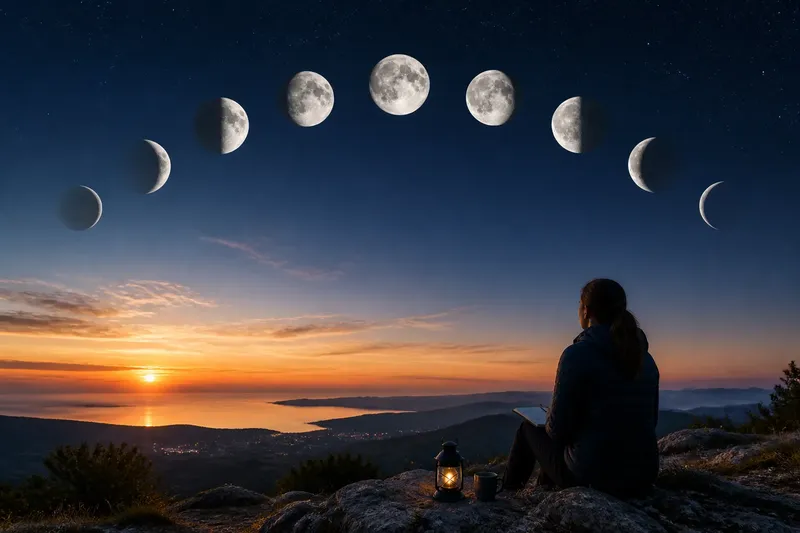
A single night offers a striking scene, but not much evidence about how it changes. To recognize a pattern, an observer had to return to the same view and notice what shifted. The Moon’s changing position, a bright planet’s route among the stars, and the rising or setting of familiar groups all became clearer through repetition.
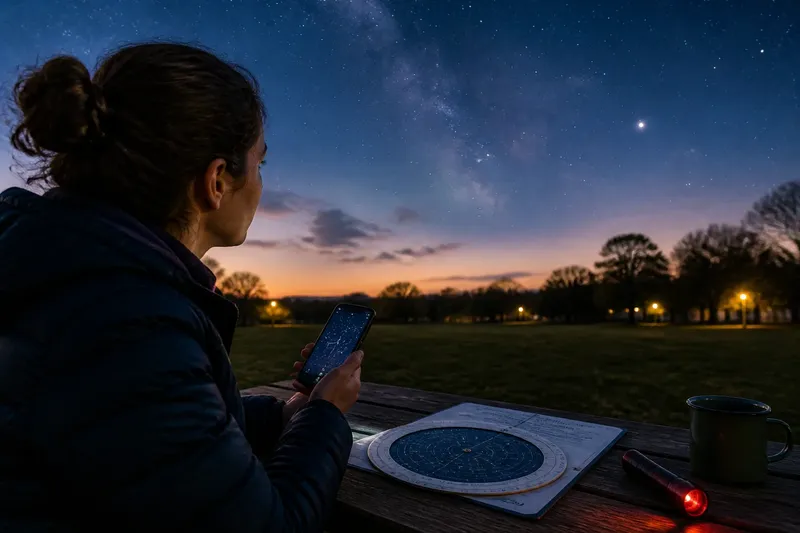
Observation did not require a lens. The unaided eye could distinguish bright objects, follow their positions against nearby stars, and notice when a familiar sight appeared earlier or later in the year. People could record these observations in memory, marks, drawings, or written notes. The essential tool was a consistent comparison: the sky on one occasion against the sky on another.
Consistency mattered because the sky is viewed from a turning Earth. Stars appear to sweep across the night, while the Sun and Moon also change their positions over longer intervals. Without separating these motions, an observer might confuse the daily rotation of the sky with the slower movement of an individual object. Tracking the same landmarks helped reveal which change was which.
Calendars grew from recurring celestial events
Celestial cycles offered a way to organize time when there was no clock on every wall. A lunar cycle supplied a visible sequence of phases. The Sun’s changing position along the horizon and the seasonal return of certain stars could help mark the progression of the year. These signs were useful not because every cycle fit neatly into a single scheme, but because they recurred in recognizable ways.
Communities could connect observations to activities such as preparing fields, traveling, or holding ceremonies. The sky did not dictate those choices by itself; local climate and custom mattered too. But a recurring celestial event could serve as a shared marker, helping people coordinate expectations across a season.
Different celestial cycles do not line up perfectly. A calendar based on lunar months, for instance, does not automatically keep the same relationship to the seasons. That mismatch invited adjustment and careful recordkeeping. It also shows that early skywatching was not simply a matter of noticing a pattern once. People had to compare cycles over time and decide how a calendar should account for their differences.
Direction depended on place and timing
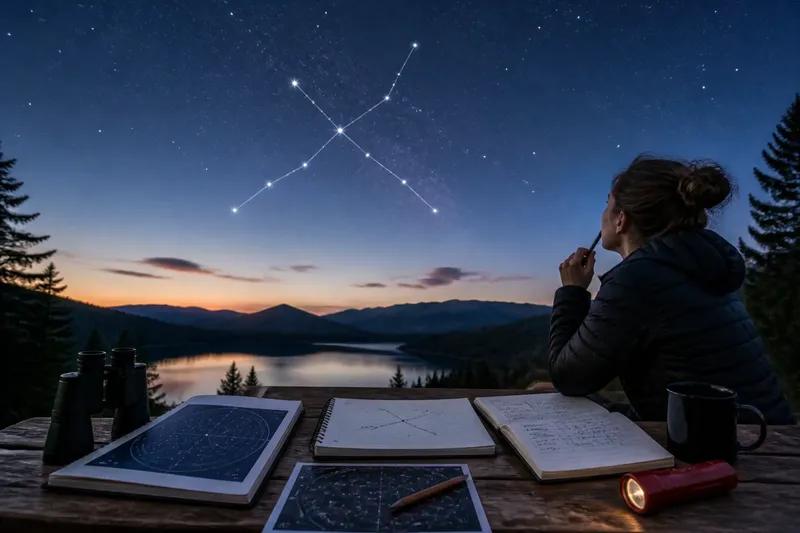
The sky could also help travelers orient themselves. The apparent paths of stars differ with location, and some stars stay near the direction of the celestial pole while others rise and set. Knowing which stars appeared at a particular time could provide a rough sense of direction or season, especially when a journey crossed terrain with few familiar landmarks.
Such guidance had limits. A star’s apparent height changes with the observer’s location, and clouds or a bright horizon can hide useful signs. Navigation from the sky therefore depended on learning local appearances and combining them with other knowledge, such as coastlines, winds, or remembered routes. It was a practiced skill, not a universal map that worked identically everywhere.
Say an invented traveler is crossing an open plain and recognizes a familiar star group rising in the eastern part of the sky. By comparing its position with the time of night and the direction of the route, the traveler could make a rough orientation check. The expected result would be a better sense of whether the journey remained on course, not a precise location or an infallible bearing.
Records turned impressions into comparisons
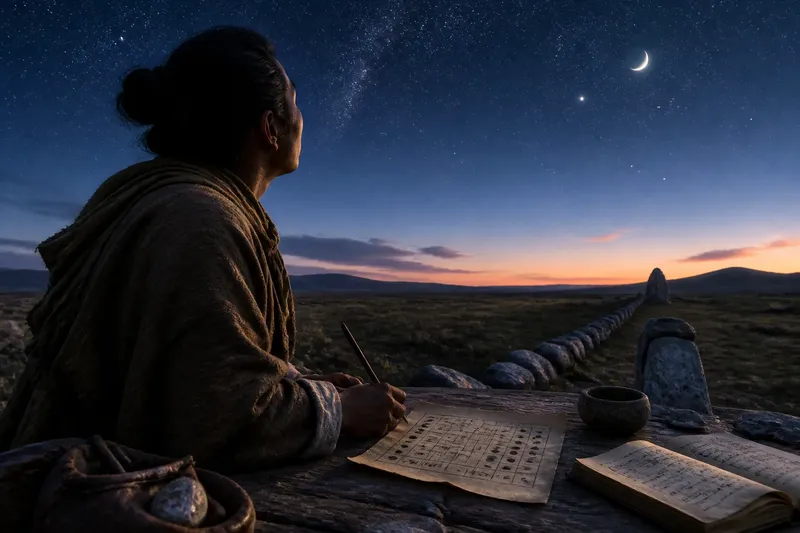
Human memory is good at recognizing a striking sight and less reliable at preserving its exact position after a long interval. Marks on a surface, aligned stones, or written descriptions could make comparison more durable. The form varied, but the purpose was similar: retain enough information to ask whether the same event returned, arrived earlier, or appeared somewhere different.
Some observations could be made without specialized equipment. A fixed horizon, a repeated viewing place, and a simple record of where an object rose or set could reveal gradual shifts. A measured alignment might help track a seasonal sunrise, although its meaning depended on the landscape and the observer’s method. An alignment alone does not establish what its builders intended; interpretation needs more than a suggestive direction.
What made these records scientifically useful was not their modern precision. It was the habit of checking a claim against another observation. If a predicted event did not occur when expected, the calendar or the observer’s assumptions might need revision. That willingness to compare and correct is a central part of astronomy, whether the instrument is an observatory telescope or the unaided eye.
Naked-eye astronomy? What could observers actually see?
Could people tell planets from stars?
Bright planets can be recognized because they shift their positions against the background stars over time, while most stars keep the same patterns relative to one another. A single glance may not settle the identification, but repeated views can make the difference apparent.
How did observers track the Sun?
They could watch where it rose or set along the horizon and compare those places across the year. The changing position offered a seasonal signal, though the exact view depended on the observer’s location and nearby terrain.
Did naked-eye observers understand what the sky was made of?
They could build reliable descriptions of visible motion without knowing the physical causes as modern astronomy explains them. A careful record of where an object appeared was a distinct achievement from an accurate theory of why it moved.
What was not worth the effort?
Trying to infer a complex celestial system from one unusual sight was less useful than keeping a modest, repeated record. An isolated appearance might be misremembered or obscured by weather, while a pattern checked across many observations could be compared with ordinary expectations.
Observation separated a pattern from an explanation
People could agree that an object appeared in a certain part of the sky and still disagree about what caused its motion. Describing what could be seen and explaining why it happened are separate tasks. Before telescopes, observers could accumulate detailed descriptions of the Moon, planets, stars, and Sun, but the unaided eye could not reveal every physical feature or settle every question about the structure of the universe.
That distinction helps avoid two opposite errors: treating early skywatchers as if they lacked careful methods, or assuming that accurate observation automatically produced modern explanations. An observer may predict a recurring event while holding a mistaken account of its cause. The prediction can still be useful, and the mismatch between prediction and observation can later prompt a better account.
Tools that came later expanded what astronomers could see, but they did not replace the value of a long, consistent record. Before the telescope, naked-eye sky observation already connected the heavens to calendars, travel, and disciplined comparison. When you look up, notice not only what is bright but what returns, what shifts against its neighbors, and what changes with the season; those are the clues that make a sky more than a collection of lights.