The Constellation Shortcut That Can Mislead
Learn why constellation stars only appear grouped from Earth, and use a simple observing routine to separate sky patterns from real distances.

The common constellation mistake is to treat a recognizable pattern as a neighborhood: stars that look close together in the sky must be close together in space. That shortcut can turn a useful map into a misleading picture, because the pattern records where stars appear from Earth, not how far apart they are. A week of brief, careful observations can make the distinction much easier to see.
A constellation is a view from one particular place
A constellation is a defined region of the sky, often recognized through a pattern of bright stars. The familiar outline is a way for observers on Earth to organize directions overhead. It does not, by itself, say that the stars share a physical location, age, origin, or distance from us.
Think of two distant mountain peaks that line up when viewed from a particular valley. Their apparent alignment tells you about your viewpoint, not the ground between the peaks. In the same way, stars can appear beside one another because they lie along nearly the same direction in our sky, even though one may be much nearer than another.
Astronomers use the term line of sight for that direction from an observer toward an object. Looking along one line of sight can bring far-separated objects into a compact-looking pattern. The constellation figure is therefore a projection: a three-dimensional arrangement represented on the sky as though it were a dome.
This does not make constellations false or useless. They are dependable landmarks for describing where to look, sharing observations, and dividing the sky into named regions. The important distinction is between a pattern that is useful on a chart and a cluster of stars that are physically near one another.
Apparent spacing and real distance answer different questions
When two stars look close together, their angular separation is small. Angular separation describes the angle between their directions as seen from Earth. It is not a measurement of the gap between the stars in space. A pair can have a small angular separation and still be widely separated in depth.
Distance from Earth is another matter. Astronomers estimate stellar distances using methods such as parallax, the slight apparent shift of a nearby star against more distant background stars as Earth changes position in its orbit. A sky map usually emphasizes directions and apparent positions; it may not show depth at all. A distance catalog or a three-dimensional visualization is needed to investigate that extra dimension.
Brightness can also confuse the eye. A bright-looking star is not necessarily nearer than a dim one. Its appearance depends on its intrinsic light output as well as its distance, and observing conditions can affect how clearly it stands out. So neither brightness nor apparent closeness is a reliable shortcut to a star’s place in space.
There are real groups of stars that are physically associated, including open clusters. Their stars can appear gathered in a small region, and astronomers can examine their distances and motions to assess whether they belong together. But a constellation outline is not automatically one of these groups. The two ideas answer different questions: a constellation tells you where a region or pattern is in the sky, while a cluster describes a physical association.
Use a week of observations to separate pattern from depth
This routine uses the same patch of sky several times, with a map for orientation and a distance source for context. Choose a constellation that is easy to recognize from your location and visible at a convenient time. Orion or Cygnus may work for many observers at suitable times of year, but the best choice depends on season, latitude, weather, and the buildings or trees around you.
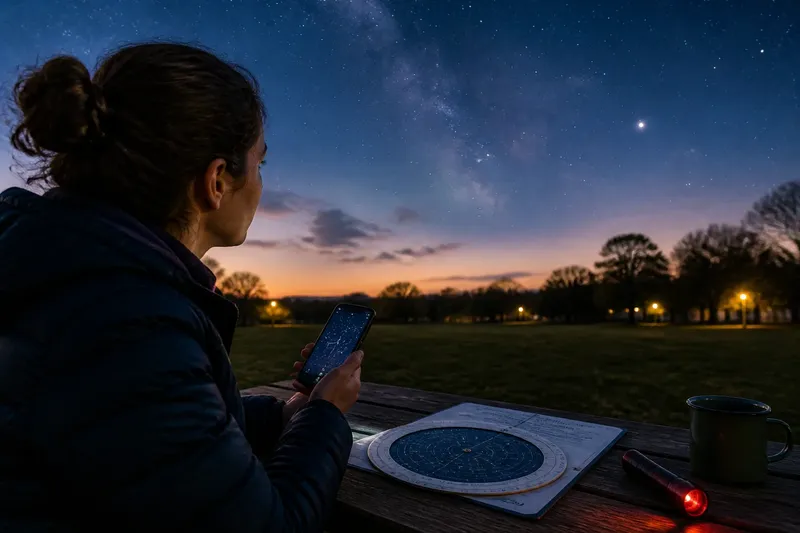
- First clear evening: Find the constellation with a printed sky chart or a reputable sky app. Note which stars define the outline, and sketch their positions as you see them. Do not add depth or connect the sketch to a supposed physical shape.
- Next observing session: Return to the same pattern and check its orientation. Notice that the outline is a way to recognize a region from your viewpoint. If the constellation has shifted across the sky since your earlier look, that movement reflects Earth’s rotation, not stars rearranging their positions in space.
- Third session: Choose two or three prominent stars in the pattern. Look up their distances in a reliable astronomy reference, keeping the units and the source’s definitions in view. Record the values beside the names rather than trying to infer depth from how close the stars look.
- Fourth session: Compare the distance entries. Ask whether the stars with the smallest apparent gap are also the ones with the smallest difference in distance. The result may vary from pair to pair; the point is to test the visual shortcut, not to expect one particular arrangement.
- Fifth session: Check whether the reference describes any of your selected stars as part of a cluster or another associated group. Keep that information separate from the constellation name. A star can lie within a constellation’s region without being physically connected to its most familiar outline.
- Final session: Redraw the constellation as a flat sky pattern, then make a second sketch using distance as a rough depth cue. Treat the second sketch as a simplified aid, not an exact model: a two-dimensional page cannot preserve every direction and distance at once.
Say you choose three stars in Cygnus and find that their cataloged distances differ substantially. On your first sketch, their apparent positions still form part of the familiar pattern; on your second, you mark one as nearer and the others as farther away. The expected observable result is not a new shape in the sky, but a clearer understanding that the same pattern can contain stars at different depths.
Keep the sky map and the distance source in their proper roles
A planisphere or printed star chart is useful for learning directions and identifying constellations. A sky app can make it easier to match a point overhead to a star name, especially when a pattern is unfamiliar. Neither should be mistaken for a depth diagram unless it explicitly presents distance information. Most ordinary finder views are designed to help locate objects on the sky, not to show their three-dimensional arrangement.
For distance context, consult a reputable astronomy reference or a catalog that explains what its distance values represent. Entries can differ in precision and method, so avoid treating every displayed value as exact. You do not need to chase every uncertainty to understand the central point: apparent position and distance are separate properties.
What is not worth the effort is trying to judge a star’s distance by eye, or memorizing a long list of values before you can recognize the pattern. A modest comparison of a few named stars is enough to expose the mistaken assumption. If the reference offers more detail than you need, return to the simple question: does this source describe where the star appears, how far away it is, or whether it belongs to a physical group?
What should you ask when a pattern looks like a group?
Are stars in one constellation physically close to each other?
Not necessarily. A constellation groups stars by their apparent location and customary pattern in Earth’s sky, and those stars may lie at very different distances from us and from one another.
Does a tight-looking pair mean the stars are near each other?
No: a tight pair has a small angular separation from our viewpoint. Distance information is needed to tell whether the stars are physically close, far apart, or simply aligned along the same direction.
Is every constellation a real star cluster?
No. A star cluster is a physical grouping assessed using evidence such as distance and motion, while a constellation is a named sky region or recognizable pattern. Some cluster members can appear within a constellation, but the terms are not interchangeable.
Can I tell how far away a star is by how bright it looks?
Not reliably. A star’s apparent brightness depends on its intrinsic light output and distance, while Earth’s atmosphere and viewing conditions can also influence its appearance. Use a suitable astronomy reference for distance rather than treating brightness as a distance scale.
Let the pattern guide your eyes, not your model of space
Once the distinction becomes familiar, constellations gain a more precise role. They remain practical signposts: Orion helps you locate a region, Cygnus gives you a recognizable outline, and a chart lets another observer understand which patch of sky you mean. What they do not provide on their own is a three-dimensional map of the stars.
On your next clear evening, use the constellation first to find the stars, then let a distance reference complicate the picture. That small change in habit preserves the convenience of star patterns while keeping the scale of space in view. The constellation shortcut is useful as long as you remember what it shortcuts: orientation, not distance.